Earning screen time by walking sounds like a gimmick until you try it for a week. This post explains exactly how the mechanic works in Skrid, what a normal day looks like, and why the coin system is built the way it is.
If you want the background on why we built the app around walking in the first place, that story is here. This one is about the practical loop.
The idea in one paragraph
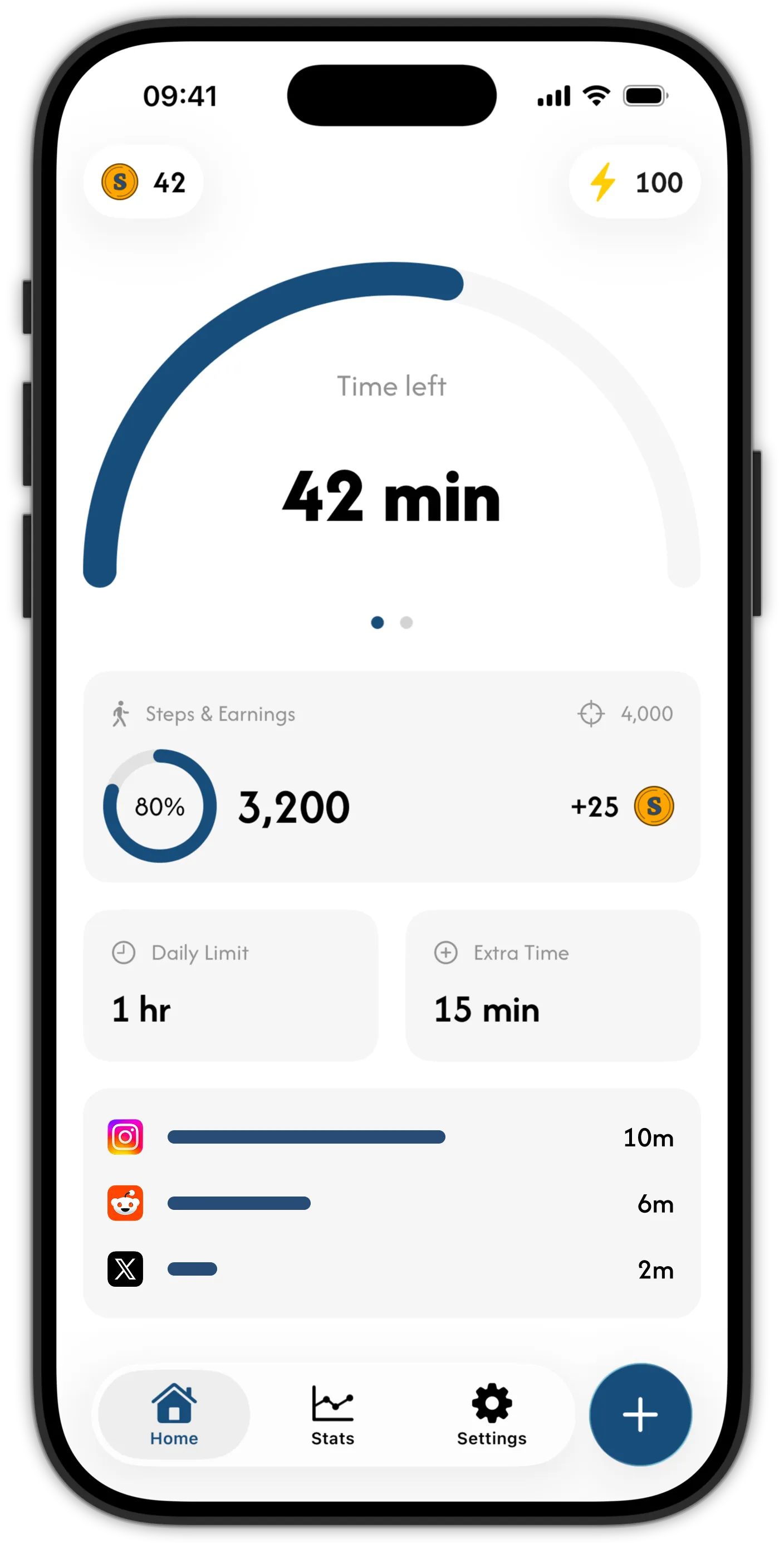
You set a daily screen time limit and pick the apps it applies to. While you are under the limit, everything works as normal. Every step you take earns coins. When you hit your limit, Skrid blocks the apps you chose. If you want more minutes, you spend coins to buy them. If you have no coins, the fix is a walk.
Steps become coins, continuously
Skrid does not wait for you to complete some fixed batch of steps before paying out. Coins accumulate continuously as you walk. A five minute walk to the bakery earns something. Pacing around the kitchen while you are on a call earns something. The reward stays connected to the behavior: you moved, you earned.
Some apps in this category use a fixed exchange, for example 100 steps for one minute of app access. Skrid deliberately separates the two with a currency in the middle. Steps earn coins, and coins buy minutes. That separation is what makes the next part work.
Spending coins is your decision
When the block kicks in, Skrid does not automatically convert your steps into more scrolling. You see your coin balance and decide whether the extra minutes are worth it. Ten coins for ten more minutes? Some evenings, yes. Other evenings you look at the price, close your phone, and keep the coins for tomorrow.
That pause is the feature. Feeds are engineered to remove every moment of decision between you and the next video, which is how the dopamine loop keeps you scrolling past the point of enjoying it. Skrid puts one decision back in the loop, and attaches a price to it.
The energy system rewards showing up
Skrid has an energy meter that starts at 100. Hit your daily step goal and it stays full. Miss a day and it drops. When your energy is low, the same number of steps earns fewer coins until you get back on track by hitting your goal again.
The point is to reward consistency over cramming. One long Sunday hike cannot bankroll a week of sitting still. A modest walk every day beats a heroic walk once a week, both for your coin balance and for your health. On that second point, the research is clear that you need fewer daily steps than you think, and that consistency matters more than peaks.
Strict or flexible, you choose
You can change your daily limit and step goal whenever you want. Making your limits stricter is always free. Loosening them or unblocking an app costs coins, so relaxing the rules is possible but never frictionless. Some people run Skrid as a hard daily cap, others as a gentle tax on their scrolling. Both work.
What a day with Skrid looks like
- Morning: you have your full daily limit, say one hour, and yesterday’s leftover coins.
- Through the day: commute, errands, and a lunch walk quietly fill your coin balance.
- Evening: you hit your limit mid scroll. The blocked apps close.
- The decision: spend coins for another fifteen minutes, or keep them and do something else.
- If the balance is empty and you genuinely want more time, the answer is a walk around the block.
Skrid is free on the App Store for iPhone and iPad running iOS 26 or later. The blocking runs on Apple’s Screen Time framework, nothing is blocked until you set it up yourself, and Skrid never sees what you do inside your apps.